For anyone planning a relocation, a job transfer, or even purchasing a vehicle from another city, understanding the car transport cost per km in India is the first step to a smooth, budgeted move. As a logistics professional with over a decade in the auto transport industry, I can tell you that while everyone wants a simple “per kilometer” rate, the final price is a blend of multiple factors.
In 2026, with fluctuating fuel prices, evolving road infrastructure, and changing consumer demand for safer transport, having a clear and updated guide is more crucial than ever. This guide is for every car owner—whether you’re moving a humble hatchback or a luxury SUV—who wants to make an informed, cost-effective, and safe decision.Understanding the exact car transport cost per km in India helps you compare quotes smartly and avoid hidden relocation charges.
What Is Car Transport Cost Per Km?
In simple terms, the car transport cost per km is a method transporters use to calculate the base price of your move. It refers to the rate (in ₹) charged for every kilometer your vehicle travels from pickup to drop-off location.
It’s important to distinguish this from flat pricing. A flat price is a single, all-inclusive quote for the entire job. Per-km pricing, on the other hand, forms the core of the quote, upon which additional charges (like tolls, fuel surcharges, or service fees) are added.
When is per-km pricing used? Almost universally. Transporters use it as the foundational metric to create your final quote. Whether you get a quick online estimate or a detailed proposal from an agent, it’s calculated by multiplying the approximate distance of your route by the per-km rate suitable for your vehicle type and transport mode.
Table of Contents
Average Car Transport Cost Per Km in India (2026)
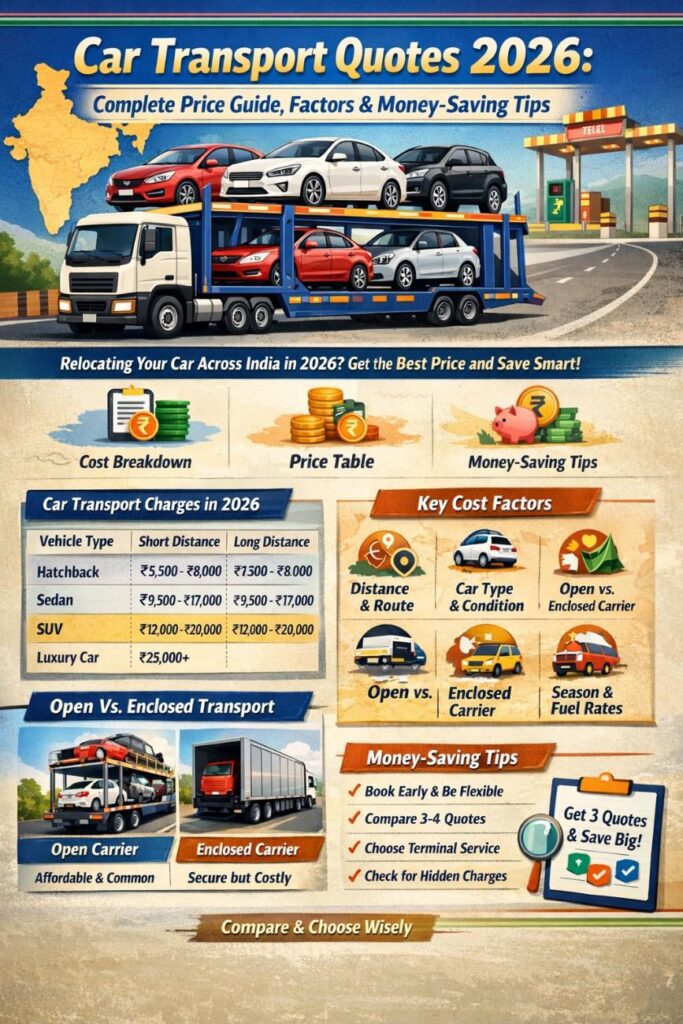
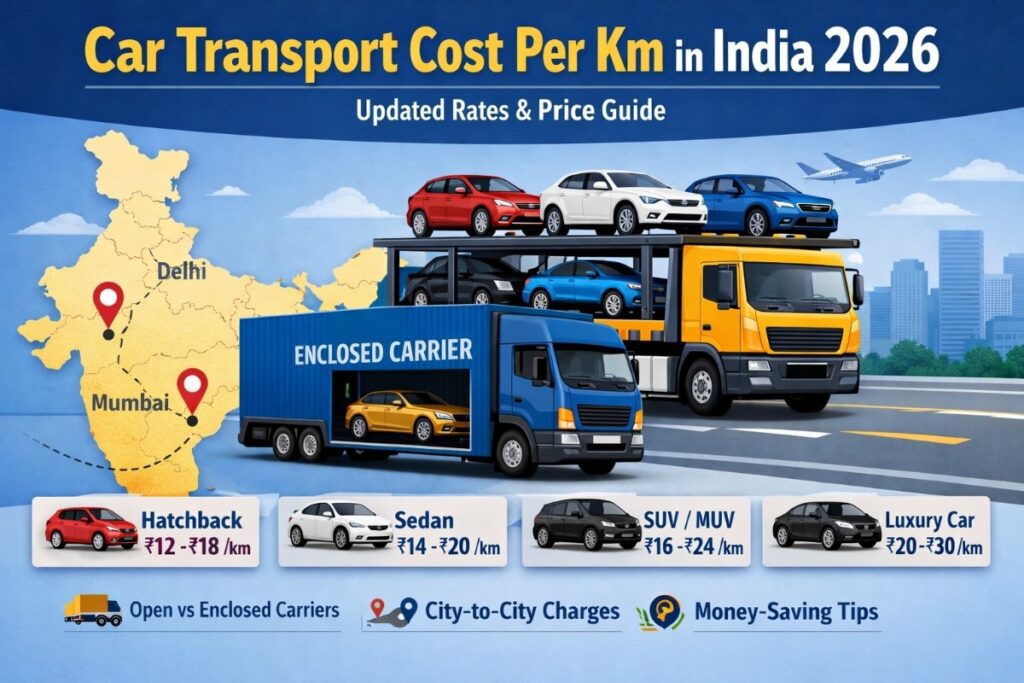
The following estimates reflect the current car transport cost per km in India based on vehicle type and transport mode. Based on current market trends and 2025-2026 projections, here are the realistic price ranges you can expect. Remember, these are base car carrier charges per km and the final door-to-door cost will be higher.
Hatchbacks (e.g., Alto, Swift): ₹12 – ₹18/km on an open carrier.
Sedans (e.g., Dzire, Honda City): ₹14 – ₹20/km on an open carrier.
SUVs/MUVs (e.g., Creta, Scorpio): ₹16 – ₹24/km on an open carrier.
Luxury Cars (e.g., Audi, BMW): ₹20 – ₹30/km on an open carrier.
The most significant price difference comes from your choice of transport type. An open carrier is the standard, cost-effective option where your car is transported on an open trailer along with other vehicles. An enclosed carrier, which provides a protected garage-like environment, costs significantly more—typically 40-60% above open transport rates—and is recommended for high-value, classic, or luxury vehicles.
Car Transport Cost Per Km – 2026 Price Guide
The table below summarizes the average per-kilometer rates for different vehicle types. Important Note: These are base transport rates. Your final car relocation cost per km will include GST, tolls, and other service charges.Below is a detailed breakdown of the average car transport cost per km in India for 2026.
- Vehicle Type: Hatchback
- Open Carrier (₹/km): 12 – 18
- Enclosed Carrier (₹/km): 20 – 28
- Recommended For: Standard daily-use cars; budget-conscious moves.
- Vehicle Type: Sedan
- Open Carrier (₹/km): 14 – 20
- Enclosed Carrier (₹/km): 22 – 30
- Recommended For: Mid-size family cars; common for corporate relocations.
- Vehicle Type: SUV / MUV
- Open Carrier (₹/km): 16 – 24
- Enclosed Carrier (₹/km): 25 – 35
- Recommended For: Larger vehicles like SUVs and premium 7-seaters.
- Vehicle Type: Luxury Car
- Open Carrier (₹/km): 20 – 30
- Enclosed Carrier (₹/km): 30 – 45
- Recommended For: High-end luxury sedans, SUVs where extra protection is valued.
Factors That Affect Your Car Transport Cost Per Km
Why does a quote from Delhi to Mumbai vary between companies and even days? Here are the key factors that sharpen or flatten that vehicle transport price per km.
- Total Distance: This is the primary multiplier. Longer distances increase total fuel, driver, and maintenance costs for the carrier.
- Vehicle Size & Weight: A compact hatchback occupies less space and weight than a full-size SUV, allowing transporters to optimize carrier load. Larger, heavier vehicles command a higher per-km rate.
- Transport Type (Open/Enclosed): As shown in the table, choosing an enclosed carrier for added protection increases your enclosed car transport cost substantially.
- Fuel Prices & Tolls: Diesel prices directly affect operating costs. Additionally, toll charges on national highways are typically passed on to the customer and can add a significant amount to the final bill.
- Route & City Type: Metro-to-metro routes (e.g., Delhi to Mumbai) are often more competitive than trips to or from tier-2 or remote cities, which may involve empty return trips for the carrier. Difficult terrain (e.g., hilly regions) can also increase costs.
- Insurance Coverage: While basic transit insurance is usually included, opting for comprehensive “door-to-door” insurance or declaring a higher insured value will increase the cost.
- Seasonal Demand: Relocation peaks during summer vacations, year-end transfers, and festive seasons (like Diwali) can drive up prices by 15-30% due to high demand.All these variables directly influence the final car transport cost per km in India quoted by transport companies.
Short Distance vs. Long Distance: How Per-Km Cost Changes
A crucial insight from the industry is that the effective car transport cost per km often decreases as the distance increases. This is due to the economics of logistics: fixed costs like pickup, paperwork, and carrier mobilization are spread over a greater number of kilometers.
Example Calculation:
- Short Haul (400 km): Total cost might be ₹7,000. Effective rate = ₹7,000 / 400 km = ₹17.5/km.
- Long Haul (1,300 km): Total cost might be ₹18,000. Effective rate = ₹18,000 / 1,300 km = ₹13.8/km.
This clearly shows how the effective car transport cost per km in India reduces over longer distances. This is why many transporters provide price brackets for distance ranges rather than a single rigid per-km rate.
City-to-City Car Transport Cost Examples
Let’s translate per-km rates into real-world car transport charges city to city for some of India’s busiest routes.
- Route: Delhi to Mumbai (~1,450 km)
- Car Type: Mid-size Sedan
- Approx. Total Cost (Open Carrier): ₹12,000 – ₹18,000
- Effective Per-Km Cost: ~₹8.3 – ₹12.4/km
- Route: Bangalore to Chennai (~350 km)
- Car Type: Hatchback
- Approx. Total Cost (Open Carrier): ₹4,000 – ₹9,000
- Effective Per-Km Cost: ~₹11.4 – ₹25.7/km (Note: Higher per-km due to short distance)
- Route: Pune to Hyderabad (~560 km)
- Car Type: Compact SUV
- Approx. Total Cost (Open Carrier): ₹6,500 – ₹11,000
- Effective Per-Km Cost: ~₹11.6 – ₹19.6/km
- Route: Kolkata to Delhi (~1,550 km)
- Car Type: Sedan
- Approx. Total Cost (Open Carrier): ₹18,000 – ₹20,000
- Effective Per-Km Cost: ~₹11.6 – ₹12.9/km
- Let’s understand how the car transport cost per km in India converts into actual city-to-city pricing.
How to Calculate Your Car Transport Cost Per Km
You can create a rough estimate yourself before seeking official quotes.
- Find the Road Distance: Use Google Maps or another reliable source to find the highway distance between your pickup and drop-off cities.
- Identify Your Base Rate: Refer to the price guide above (e.g., ₹14-₹20/km for a sedan on an open carrier).
- Calculate Base Transport Cost: Multiply the distance by the mid-point of the rate (e.g., 1000 km x ₹17/km = ₹17,000).
- Add Surcharges: Factor in an additional 15-20% to cover GST, tolls, and service charges. (e.g., ₹17,000 + 20% = ₹20,400).
- Adjust for Variables: Consider if you need enclosed transport (add 50%), if it’s peak season (add 15-20%), or if your destination is remote (add 10%).
This self-calculated figure will give you a strong budgetary benchmark to evaluate formal quotes against.
How to Reduce Your Car Transport Cost Per Km
Getting the best value doesn’t always mean choosing the cheapest quote. Here are practical, professional tips to secure a fair price.
- Choose an Open Carrier: This is the single biggest cost-saving decision, perfectly safe for most standard vehicles.
- Be Flexible with Dates: Avoid moving in peak seasons (May-July, December). A mid-month, mid-week pickup can sometimes offer better rates.
- Book in Advance: Last-minute bookings often incur premium charges. Plan 2-3 weeks ahead.
- Compare Multiple Quotes: Use digital platforms to get and compare 3-5 detailed quotes from verified transporters. Look for transparent breakdowns.
- Opt for Terminal-to-Terminal: If possible, dropping off and picking up your car at the transporter’s hubs (instead of door-to-door) can reduce costs.
- Ensure Clear Communication: Provide accurate car dimensions and condition. Hidden fees can appear for oversized vehicles or cars that are not in running condition.
Frequently Asked Questions (FAQs)
Q1. What is the average car transport cost per km in India in 2026?
For a standard sedan on an open carrier, the average base rate is between ₹14 and ₹20 per km. The final, all-inclusive door-to-door cost will be higher after adding taxes and surcharges.
Q2. Is insurance included in the per-km pricing?
Yes, reputable transporters include basic transit insurance in their quoted price. However, you must verify the sum insured and the policy terms. For luxury cars, you may need to purchase additional coverage.
Q3. Is enclosed transport worth the extra cost?
It depends. For brand-new cars, vintage classics, or ultra-luxury vehicles where even minor paint chips are unacceptable, the enclosed car transport cost is a worthwhile investment. For everyday cars, an open carrier is a safe and standard choice.
Q4. Can the per-km price be negotiated?
Yes, to an extent. While base rates are fairly standard, there is often room to negotiate, especially for long-distance routes or if you are flexible. The best negotiation tool is a comparable quote from a competitor.
Q5. How accurate are online car transport cost calculators?
They provide excellent estimates to help you budget. They factor in distance, car type, and mode to give a realistic price range. However, the final quote from the company after vehicle inspection will be the binding figure.
Q6. What documents are required for car transport?
You will typically need a copy of the vehicle’s Registration Certificate (RC), your valid ID proof (Aadhaar, PAN), and a signed transportation authority letter. If the car is under finance, a No Objection Certificate (NOC) from the bank is mandatory.
Q7. Why does car transport cost per km in India vary between companies?
Rates differ due to fuel prices, route demand, insurance coverage, and service quality.
Conclusion
Navigating car transport charges in India requires understanding that the per-kilometer rate is just the starting point. Your final cost is a tailored calculation based on your car, route, timing, and service choices.
As we move through 2026, the logistics industry is becoming more transparent and customer-focused. Use the detailed guides and price ranges provided here not to just find the lowest cost, but to identify the best value—where fair pricing meets professional service, proper insurance, and a trustworthy transporter. Comparing the car transport cost per km in India carefully ensures you choose the right balance of price and service quality.
Plan ahead, ask the right questions, and compare your options carefully. A well-informed decision is the key to a stress-free car relocation experience.