Planning to relocate your car across India in 2026? The first thing you’ll look for is a price quote. You might quickly notice that quotes for the same route can vary wildly between companies. As we step into 2026, with fuel prices, toll taxes, and logistics dynamics constantly shifting, understanding how car transport quotes are calculated has never been more crucial. This guide will explain everything you need to know—from the latest car transport cost in India to the smartest money-saving tips—to help you make an informed, cost-effective, and safe decision for your vehicle’s journey.
What Are Car Transport Quotes?
Let’s start with the basics. A car transport quote is the estimated price a logistics company provides to move your vehicle from one location to another. It’s not just a random number; it’s a calculated figure based on multiple logistics factors. Think of it as a detailed budget for your car’s safe passage.
A transparent quote should typically include:
- The core transportation fee.
- Fuel surcharges and applicable toll taxes.
- Basic carrier liability insurance.
- Loading and unloading charges.
- All government taxes, primarily GST.
Be cautious of quotes that seem unusually low. They might exclude essential services or have hidden charges that appear later. Most reputable companies now offer instant online car transport quotes, which are convenient and allow for easy comparison, but always ensure you get a detailed breakdown.
Table of Contents
Car Transport Cost in India (2026 Updated Price Table)
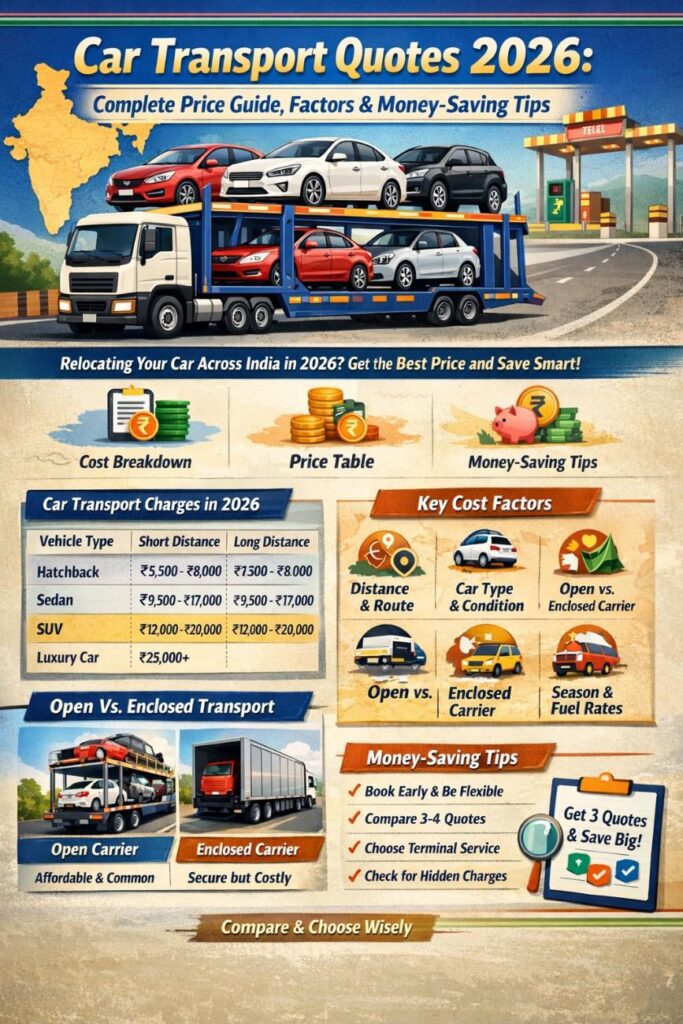
Prices are influenced by your car type and the distance it needs to travel. Here’s a practical breakdown of estimated car transport charges for 2026 to help you budget effectively.
Estimated Cost by Vehicle Type (Door-to-Door, Open Transport)
| Vehicle Type | Short Distance (Up to 500 km) | Medium Distance (500 – 1500 km) | Long Distance (1500+ km) | Approx. Per Km Rate |
|---|---|---|---|---|
| Hatchback (e.g., Swift, i10) | ₹5,500 – ₹8,000 | ₹8,000 – ₹15,000 | ₹15,000 – ₹28,000 | ₹10 – ₹18 |
| Sedan (e.g., Honda City, Verna) | ₹6,500 – ₹9,000 | ₹9,500 – ₹17,000 | ₹17,000 – ₹32,000 | ₹11 – ₹20 |
| SUV (e.g., Creta, Scorpio) | ₹8,000 – ₹11,000 | ₹12,000 – ₹20,000 | ₹20,000 – ₹38,000 | ₹13 – ₹24 |
| Luxury/SUV (Fortuner, BMW X1) | ₹10,000+ | ₹16,000+ | ₹25,000+ | ₹16+ |
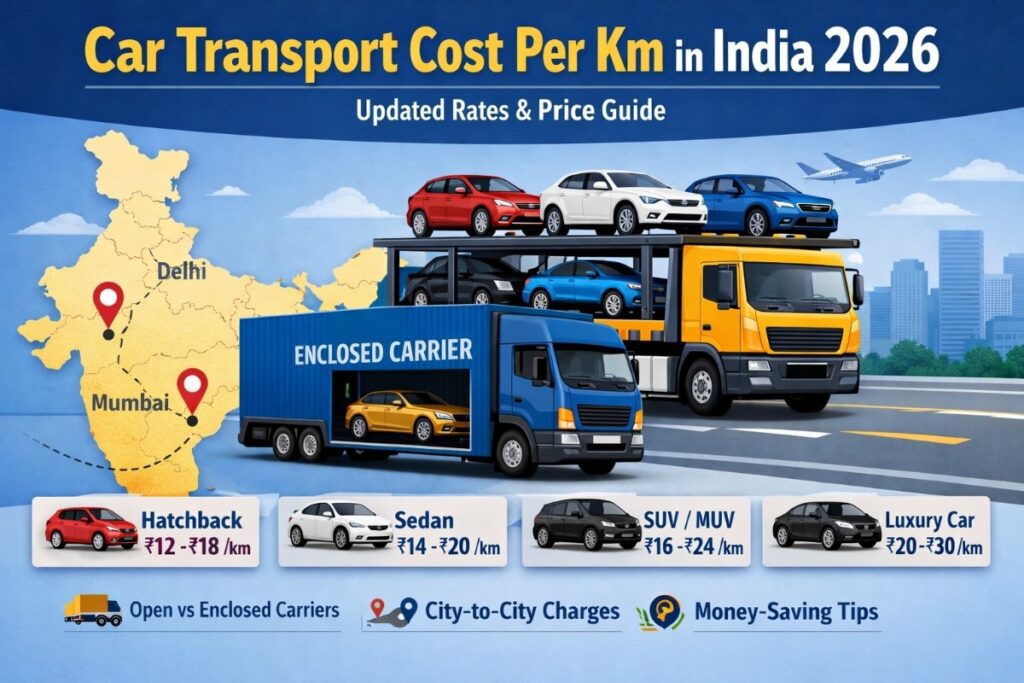
A Note on Per Km Pricing: The car shifting price per km is not fixed. It generally decreases as distance increases. Short hauls have a higher per-km cost due to base operational charges, while long-distance transport becomes more economical on a per-km basis.
Factors That Affect Car Transport Quotes in 2026
Understanding what influences the final number will help you decode any quote. Here are the key vehicle transport price factors:
1. Distance and Route Logic
This is the primary cost driver. Longer distances mean higher fuel, toll, and driver costs. However, transport between well-connected major highways and metros is often more efficient and sometimes cheaper per km than moving to or from a remote town, which may incur “last-mile” surcharges.
2. Your Car’s Type, Size, and Condition
- Size & Weight: A compact hatchback occupies less space on the carrier than a full-size SUV, hence the lower cost.
- Luxury or Vintage Models: High-value cars like Mercedes, BMW, or classic cars often require enclosed transport and extra care, increasing the cost by 30-50%.
- Non-Running Condition: If your car doesn’t start, it requires a winch and special equipment to load, adding to the final quote.
3. Open vs. Enclosed Carrier Choice
This is a major price determinant. Open car transport charges are standard and most affordable. Enclosed car transport cost is significantly higher (often 40-60% more) but provides complete protection from weather and road debris—ideal for luxury, classic, or brand-new vehicles.
4. Pickup and Delivery City Dynamics
- Metro to Metro (e.g., Delhi to Bangalore): Usually has the most competitive rates due to high demand and regular trips.
- Metro to Tier-2/3 City: Might cost more due to the imbalance in vehicle flow.
- Door-to-Door vs. Terminal: The convenience of home pickup/delivery costs more than dropping/collecting your car at the company’s terminal.
5. Season, Fuel, and Demand
- Peak Seasons: Summer (Apr-Jun) and festive months (Sep-Nov) see a surge in demand, leading to car carrier service price hikes of 15-25%.
- Fuel Prices: Volatile diesel costs often trigger a fuel surcharge.
- Insurance: Verify the included coverage amount. For adequate coverage of a high-value car, an additional premium may be required.
Open vs. Enclosed Car Transport – Price Comparison
Choosing the right carrier type is key to balancing cost and care.
Open Carrier Transport
- Cost: The standard, most cheapest car transport service option.
- Best For: Everyday used cars, hatchbacks, sedans, and SUVs.
- Pros: Highly available, cost-effective, and safe for most relocations.
- Cons: Vehicle is exposed to sun, rain, and road dust.
Enclosed Carrier Transport
- Cost: Premium service with a premium enclosed car transport cost.
- Best For: Luxury cars, vintage models, high-end sports cars, or any vehicle requiring maximum protection.
- Pros: Complete shield from weather, debris, and minor road impacts; enhanced privacy and security.
- Cons: Higher price, limited availability, and often longer booking times.
City-to-City Car Transport Charges (Examples)
To make this practical, here are realistic estimated price ranges for popular routes in 2026 for a standard sedan using an open carrier (door-to-door service):
- Delhi to Bangalore (~2,150 km): ₹18,000 – ₹25,000
- Mumbai to Hyderabad (~710 km): ₹9,000 – ₹13,000
- Pune to Chennai (~1,185 km): ₹12,000 – ₹17,000
- Bangalore to Kolkata (~1,870 km): ₹16,000 – ₹22,000
Please note: These are indicative ranges. Your final car transport charges city to city will depend on the specific factors discussed.
How to Get Accurate Car Transport Quotes
To get a reliable quote, provide clear information and ask the right questions.
What You Must Tell the Company:
- Exact pickup and delivery PIN codes.
- Make, model, variant, and year of manufacture.
- Is the car in running condition?
- Your preferred dates and type of carrier (open/enclosed).
Common Mistakes to Avoid:
- Not Getting a Written Quote: Always insist on a detailed quote via email or WhatsApp.
- Chasing the Lowest Price: An outlier cheap quote often signals hidden costs or subpar service.
- Not Checking Credentials: Always verify the company’s GSTIN, ask for insurance proof, and read genuine customer reviews.
Money-Saving Tips on Car Transport in 2026
Follow these practical car transport money saving tips:
- Book Well in Advance: Planning 3-4 weeks ahead helps you secure better rates and avoid peak-season premiums.
- Be Flexible with Dates: If possible, avoid moving during month-ends, festivals, or peak summer. Schedule for off-peak periods like late winter or monsoon (though weather is a factor).
- Choose Open Transport: For a regular car, an open carrier is a perfectly safe and much more economical choice.
- Compare 3-4 Quotes: Don’t jump on the first offer. Use aggregator websites or contact multiple providers to understand the market rate.
- Consider Terminal Service: If convenient, opt for terminal-to-terminal service, which can be cheaper than door-to-door.
- Prepare Your Car: Ensure it’s in running condition. Remove all personal belongings to reduce weight and avoid liability issues. A quarter tank of fuel is sufficient.
Hidden Charges to Watch Out For
Read the fine print. Always clarify these points to avoid surprises:
- GST Confusion: Ensure the quote is “inclusive of all taxes” to avoid an 18% addition later.
- Insurance Add-Ons: Confirm the declared value of your car under their basic insurance. Top-up coverage will cost extra.
- Storage Fees: If you delay picking up the car at destination, daily storage charges may apply.
- Cash on Delivery (COD) Charges: Some companies add a fee if you opt to pay in cash upon delivery.
- Remote Area Surcharge: Charges for locations with difficult truck access.
FAQs Section
Q1: What is the average car transport cost per km in 2026?
There’s no single average, as it reduces with distance. For long hauls (1500+ km), expect ₹10-₹18 per km. For shorter trips (under 500 km), it can be ₹15-₹25 per km due to fixed base costs.
Q2: Is insurance included in car transport quotes?
Basic third-party carrier liability insurance is almost always included. However, you must check the “sum insured” value. It might only cover a basic depreciated value. For full coverage, you may need to purchase additional insurance.
Q3: How long does car transport take from Delhi to Bangalore?
For a long route like Delhi to Bangalore (~2150 km), allow 7-10 days for standard transport. This includes time for pickup, loading, transit, unloading, and delivery. Always get an estimated timeframe in writing.
Q4: Can I negotiate car shifting charges?
Yes, you can and should! Once you have a few written quotes, use them as leverage to negotiate with your preferred company. There is often some margin for discussion, especially if you are flexible.
Q5: Is it safe to transport a car via an open carrier?
Yes, it is generally very safe. Open carriers are the industry standard, used by millions. Reputable companies secure vehicles properly. The main trade-offs are exposure to weather and road dust, not safety.
Conclusion
Navigating car transport quotes in 2026 is about being an informed customer. Remember, the true goal is not just to find the cheapest car transport service, but to find the best value—a balance of reliability, safety, and fair pricing.
Start by using the price guide here as a benchmark. Understand the factors that affect your quote, get multiple detailed estimates, and don’t hesitate to ask clarifying questions. A little research and preparation will save you money, prevent last-minute stress, and ensure your prized vehicle reaches its new home safely and securely.
Ready to Move? Get three detailed quotes today, compare them using the knowledge from this guide, and choose the partner that offers you clarity and confidence.